
Source: https://thesaigontimes.vn/
Huynh The Du - Nguyen Xuan Thanh*
(KTSG) – Since the renovation, gold has been a safe channel to store value. However, with shorter cycles, the risk level is very high. When the world gold price increases, the return on gold is also high and vice versa. The change in gold price is associated with gold fever as analyzed in the article "Macroeconomic difficulties and gold fever" in issue 16-2024, published on April 18, 2024, showing that gold price in Vietnam is closely linked to world gold price and psychological impacts, especially recently affected by world gold price.
Gold is safe in the long term
Due to the lack of complete data, we start from 1988. Figure 1 shows the consumer price index (CPI), domestic gold price (GVTN), world gold price (GVTG) and US dollar price (USD) from 1988-2023. CPI increased 36.2 times, domestic gold price increased 21.2 times, world gold price increased 4.9 times and US dollar increased 4.5 times.

In the period 2000-2023, when the stock market was established, gold increased 13.6 times; the stock index (VN-Index) increased 9.9 times; world gold increased 7.6 times; deposits in VND (TGVND) increased 4.5 times; CPI increased 3.7 times; US dollars increased 1.7 times. In the long term, gold is the safest, but few people hold assets for such a long time. With a period of 5-10 years, the results were much different.
Period 2012-2023: Gold is not an effective investment channel
In the period 2012-2023, Vietnam's average gold consumption was 62 tons/year, equivalent to 61 tons in the period 1997-2007. However, gold consumption in 2012 and 2013 was still very high (84 and 100 tons, respectively). The average gold consumption in the period 2015-2023 was 56 tons, equivalent to 55 tons in the period 1997-2005.
Gold prices fluctuated strongly in the period 2012-2022. From 2012-2015, world and domestic gold prices both decreased by about 30%; were quite stable from 2015-2018; world gold prices increased by over 40%, domestic prices increased by over 50% in the period 2018-2020; were stable from 2020-2022; and increased significantly from 2022-2023. During the whole period, the VN-Index increased by 2.73 times; the price of luxury apartments (CHCC-HCM) increased by 2.72 times; VND deposits increased by 1.69 times; domestic gold prices increased by 1.5 times; CPI increased by 1.39 times; world gold prices increased by 1.25 times and US dollars increased by 1.18 times.
2008-2012 period: Holding gold is best
During the 2008-2012 period, Vietnam consumed an average of 94 tons of gold per year. This was about 50% higher than the average of the 1997-2007 period and 3 times higher than the average of the 1988-1996 period. The high gold consumption started in 2006 and ended in 2013. The eight-year average was 91 tons/year. Vietnam experienced a period of high macroeconomic instability.

In the period 2007-2012, the world gold price doubled and the US dollar price increased by 31%, leading to a 2.84-fold increase in domestic gold prices. During this period, the CPI increased by 81%; VND deposits increased by 70%; VN-Index increased by 60%; luxury apartment prices increased by 55%. Thus, only gold increased higher than the CPI increase.
1997-2007 period: Gold has the highest return
From 1997 to 2007, Vietnam consumed an average of 61 tons of gold per year, nearly double the average of the period 1988 to 1996. However, the consumption was high in 2006 and 2007 while the growth rate in the period 1996 to 2005 was moderate and the average consumption during this period was only 55 tons/year. From 1997 to 2007, Vietnam experienced the Asian financial crisis (1997-1998) to the high expectations and boom of the asset market after Vietnam joined the WTO in 2006, from which the gold price fluctuated strongly.
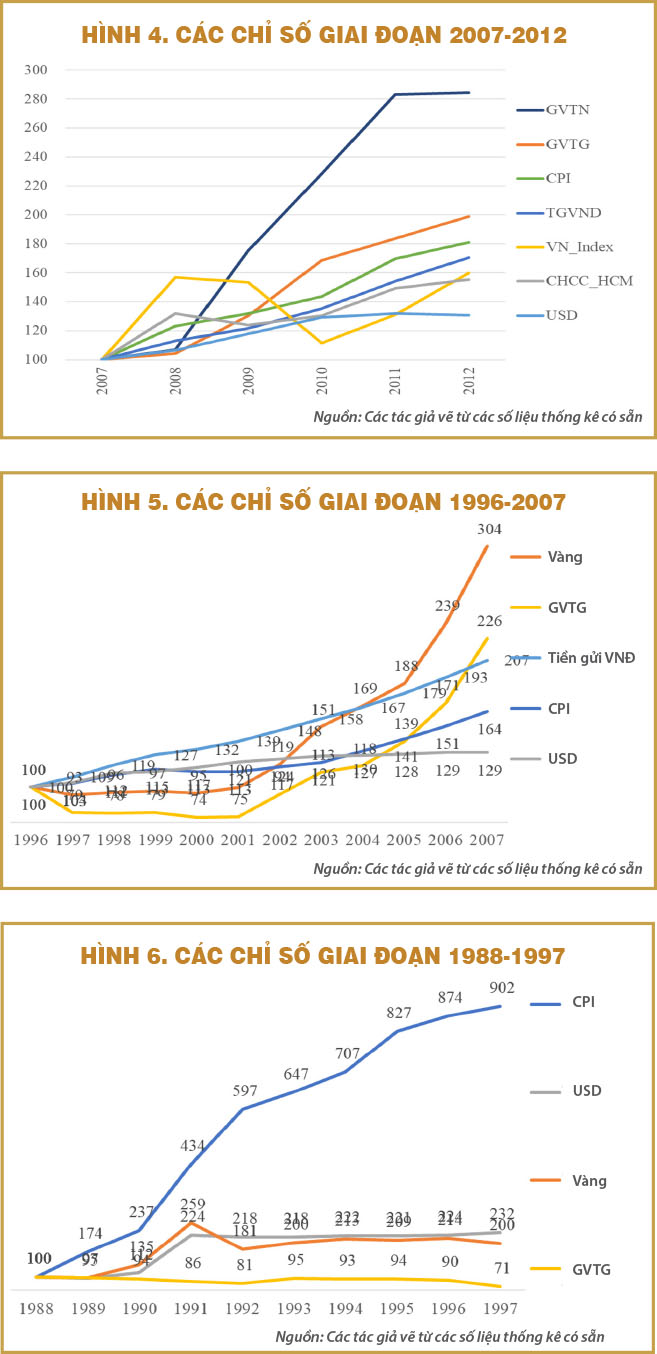
In the period 1996 to 2001 (before and after the crisis), the world gold price decreased while the domestic gold price did not fluctuate much. However, the gold price increased rapidly in the period 2001 to 2007. From 1996 to 2007, the world gold price increased by 2.3 times; the domestic gold price increased by 3.1; deposits in VND increased by 2.1 times; CPI increased by 1.6 times; and the US dollar increased by 1.3 times. In general, holding gold was a good choice throughout the period. However, it was the worst option in the period 1996-2004.
1988-1996: Holding gold was the biggest loss of assets
During this period, 263 tons of gold were consumed in Vietnam, an average of 33 tons per year. Vietnam experienced hyperinflation in the late 1980s, followed by high inflation. During hyperinflation, most asset increases were lower than inflation. From 1988 to 1996, holding gold was the worst option. During this period, the world gold price decreased by 32%; Domestic gold prices increased only 1.5 times; while CPI increased about 9 times; US dollars increased 2.3 times. Deposits in VND during this period were lower than CPI but significantly higher than holding both gold and US dollars.
During the period of hyperinflation and unrecognized private economic activities, the three monetary functions of gold were very popular. High-value assets such as real estate, televisions, motorbikes, livestock, and even agricultural products were valued and converted in gold. However, until the late 1990s and early 2000s, gold was only favored for valuing and being a means of exchange for high-value assets such as real estate.
For goods such as televisions and motorbikes, especially domestically produced goods, they were valued and converted in money instead of gold as before. The important reason for this situation is that the domestic economy has a good growth rate and the world gold price is continuously falling, holding gold is a loss, so listing the price in gold is not popular.
The above is an analysis of the operation of the gold investment channel compared to some other channels. Unfortunately, we do not have statistics on the real estate price index. However, this is a channel that is also very unpredictable and depends on the segment. Land-attached houses have the highest increase, while apartments only increase at a moderate level. Buying agricultural land with the expectation of future price increases is probably the most precarious and risky channel.
*Lecturer in Public Policy, Fulbright School of Public Policy and Management, Fulbright University Vietnam
Related Articles
Experience of some countries in managing and regulating the gold market
Quantitative analysis of the impact of gold on the Vietnamese economy