
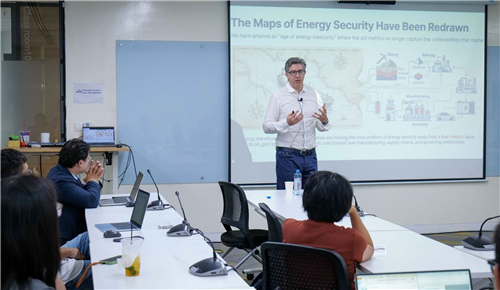
As clean energy increasingly reshapes the global economy, energy security is no longer just about oil and gas or strategic sea lanes. New chokepoints are emerging across supply chains, critical minerals, and clean technology manufacturing capabilities, raising new questions about power and dependence among countries.
These issues were at the heart of a public lecture by Prof. Edward Cunningham, Director of Ash Center China Programs and the Asia Energy and Sustainability Initiative at Harvard Kennedy School, Harvard University. Titled "Energy Systems After Bretton Woods: Security, Scale, and State Power in an Age of Fragmentation," the lecture was hosted by the Fulbright School of Public Policy and Management (FSPPM) on August 4, 2026, drawing a large audience both in person at FSPPM and online via Zoom.

Energy security is no longer just about oil and gas
To begin the lecture, Prof. Edward Cunningham argued that the map of energy security is being redrawn. Energy security used to mean one system, largely centered on fuels, with familiar concerns around oil and gas, pipelines, tankers, and strategic sea lanes. The energy transition, however, is moving the world from a "fuel-centric" to a "system-centric" approach. The chokepoints that increasingly matter lie in supply chains, critical minerals, processing, manufacturing, and the industrial capabilities behind clean energy technologies.

One of his key arguments was that major oil and gas shocks can impose significant costs, but markets can still adjust through price, demand compression, and alternative supplies. By contrast, when the chokepoint lies in specialized industrial capabilities, such as rare-earth separation and refining or permanent magnet production, higher prices cannot quickly create alternative capability. Building these capabilities can take years.
The United States and China: Two Different Forms of Energy Power
According to Prof. Edward Cunningham, the energy transition also reveals a striking contrast between the world's two largest economies. The United States has abundant fossil fuel resources, is the world's largest producer of oil and gas, and has been a net energy exporter since 2019. However, as Prof. Cunningham emphasized, "abundance is not insulation."

Oil remains a globally traded commodity. As a result, geopolitical disruptions elsewhere can still drive up energy prices for American consumers, even when domestic production is at record levels. Resource abundance provides the United States with supply security, but does not fully protect the economy from global price shocks.
China is in the opposite position. It remains highly dependent on imported fossil fuels, with roughly three-quarters of its oil and more than 40 percent of its gas imported. Much of this supply transits straits that China cannot control.

However, China has spent years building strength elsewhere in the energy system. It now holds a strong position in solar manufacturing, battery production, rare earth processing, and other parts of the clean-tech supply chain. At the same time, rapid electrification in transport and other sectors is gradually reducing the growth of its oil demand.

However, dominance is not independence, China still depends on imported minerals. The difference is that this new dependency lies within a system where China has a much stronger position and greater control.
ASEAN and the Challenge of Preserving Strategic Choice
For ASEAN, Prof. Cunningham noted that the region should not be treated as a single category. He distinguished between resource-holders such as Indonesia and Malaysia, manufacturing aspirants such as Vietnam and Thailand, and financial and service hubs such as Singapore. Vietnam, in particular, faces multiple layers of vulnerability, from fuels and clean-tech supply chains to changing trade rules and market access.

- Uyên Vũ
Related Articles
Leadership Transition at the Fulbright School of Public Policy and Management

Fulbright Bridges Scholarship Expands Opportunities for Candidates to the 2026 Fulbright Master in Public Policy Program