

What does the presence of multinational firms bring to domestic firms and economic growth? The answer lies not only in investment flows or export activities, but also in the potential for learning and technology diffusion between foreign and domestic firms.
This was the question explored by Dr. Nghiem Huynh, Assistant Professor of Economics at the University of Oklahoma, in his lecture, "Platforms for Growth? Multinationals, Trade, and Technology Diffusion" at FSPPM in mid-August. The event attracted researchers and those interested in policy issues in Vietnam, joining both in person and online.

Using the 2001 U.S.–Vietnam Bilateral Trade Agreement, the paper shows that reductions in export barriers generated substantially larger gains in exports, sales, employment, and firm entry in sectors with stronger pre-reform multinational presence. These effects arose both from multinational firms' greater ability to reallocate production and from positive spillovers to domestic firms. Survey evidence shows that domestic firms in more exposed sectors formed more links with multinationals, received more technology transfers, and made more technology modifications. The paper then embeds multinational production and learning by domestic firms in a quantitative general-equilibrium model to measure the importance of these mechanisms. The results show that the gains from trade liberalization depend crucially on multinational openness: the BTA raises Vietnam's welfare by 1.24 percent in present-value terms, compared with only 0.22 percent if Vietnam is closed to foreign firms.

In theory, the presence of foreign firms does not always generate positive effects. Foreign firms may compete with domestic firms, affect wage structures, and intensify competitive pressures on the private sector.

However, the study provides empirical evidence consistent with domestic private firms learning from foreign firms, and then uses the economic model to quantify the importance of this learning mechanism. The findings show that learning plays a significant role in shaping the gains from the interaction between international trade and the presence of foreign firms, with potentially substantial benefits for Vietnam's development.

For the academic literature, the study provides causal evidence on how trade liberalization and multinational presence interact, and connects that evidence to a quantitative account of the roles of trade, multinational production, and learning in a developing country's growth. For policymakers, the key implication is that the gains from trade openness depend on whether domestic firms can learn from and benefit from links with foreign firms. As global production patterns change, policy should pay attention not only to attracting multinational investment, but also to the conditions that allow domestic firms to learn and upgrade.
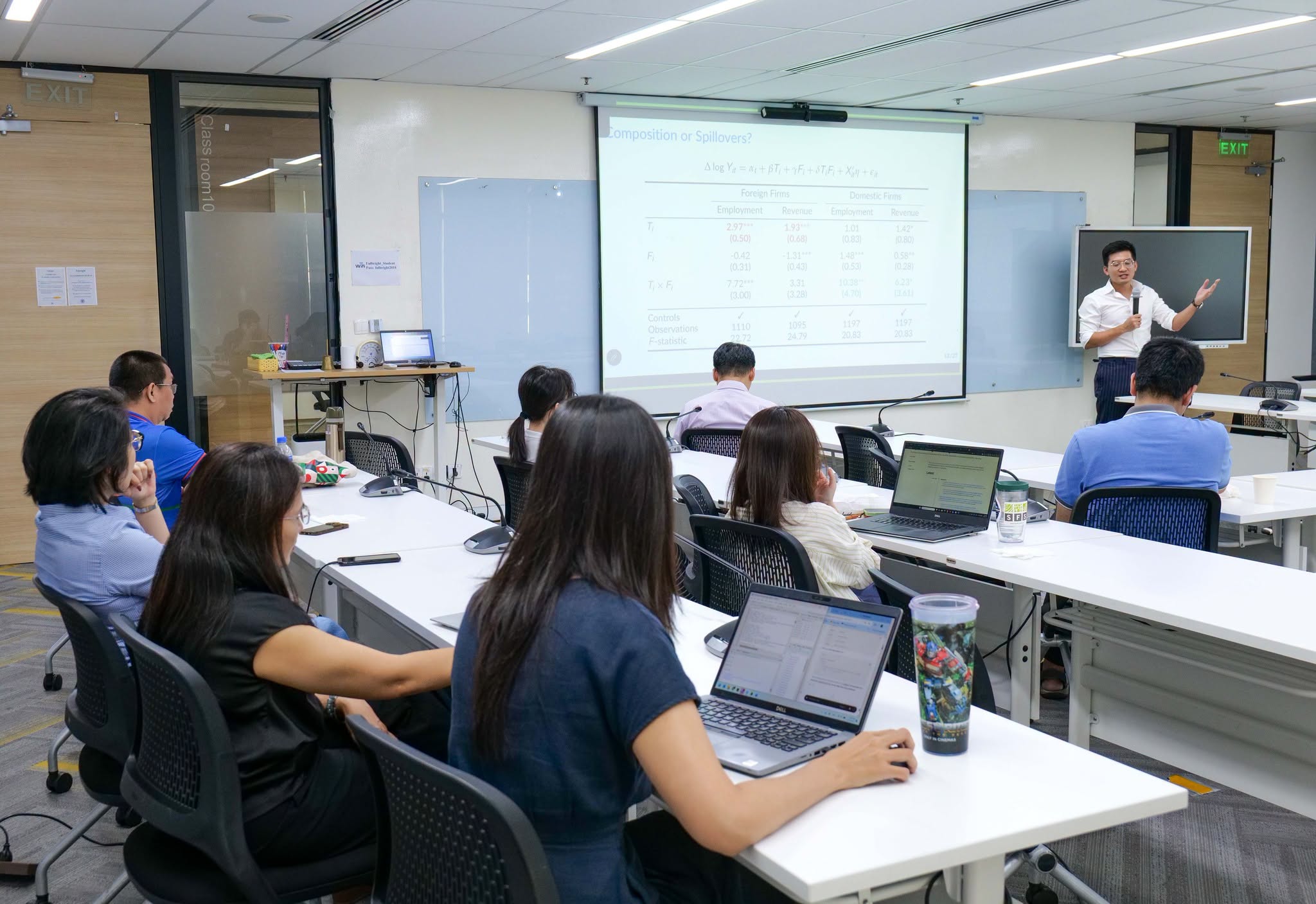
Academic research connected to Vietnam's development questions
This was the second time Dr. Nghiem Huynh presented new research at FSPPM. Reflecting on his close relationship with the School, Dr. Huynh shared: "My relationship with Fulbright is very special, and an important part of that is the support of Dr. Vu Thanh Tu Anh, Dean of FSPPM, who is deeply committed to and interested in academic research. Dr. Tu Anh has helped me view my models and research findings in closer connection with the realities of Vietnam. Whenever I have a new research project, I often share it with Dr. Tu Anh to hear his thoughts and learn from his perspective. Through these exchanges, I have had opportunities to return to FSPPM to present my work and discuss it together with the community here."

Through these academic activities, FSPPM connects scholars from Vietnam and abroad while creating a space where new research can be discussed and considered in relation to Vietnam's realities and policy issues.
- Uyên Vũ
Related Articles

Rethinking Energy Security in an Age of Fragmentation

Leadership Transition at the Fulbright School of Public Policy and Management